E8, H4 and the 600-cell
There is a special set of 120 unit quaternions (each one a rotation) that are the corners of a regular solid in four dimensions called the 600-cell. Pairing that set with a golden-ratio-scaled copy of itself gives 240 points in eight dimensions, the roots of a famous lattice called E8. The project uses this structure because every rotation in it can be written with exact whole-number arithmetic, so a state can be turned and turned back with no rounding. The current model uses only a small, 16-root piece of E8, and this chapter is careful about the difference.
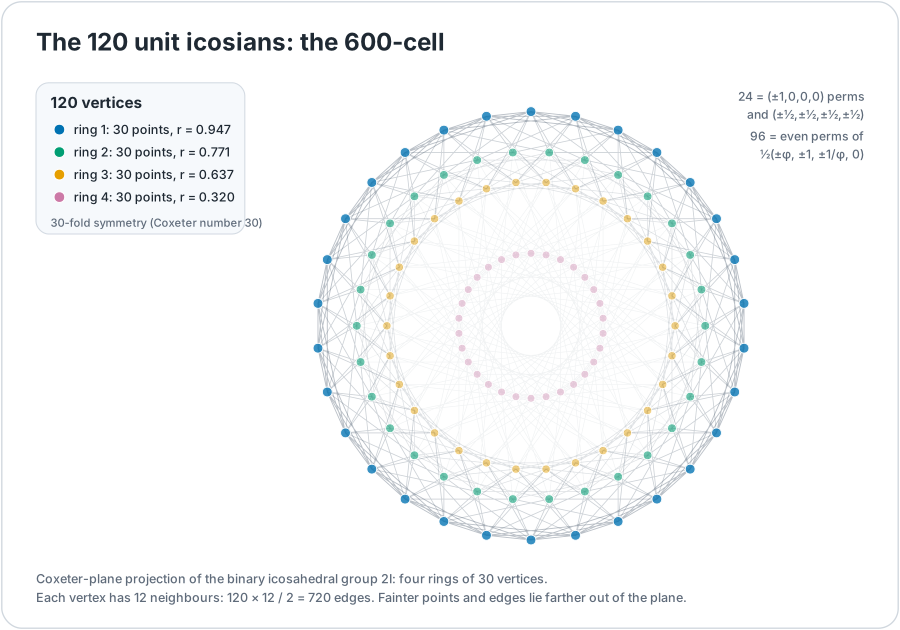
The 120 unit icosians as the vertices of the 600-cell, seen from a plane chosen to show the symmetry. Four rings of 30 points, 12 neighbours per vertex, 720 edges.
The 120 icosians and the 600-cell
The binary icosahedral group \(2I\) contains 120 unit quaternions, closed under multiplication. These are the H4 roots and the vertices of the 600-cell. They are, with coordinates in order \((w,x,y,z)\):
- 8 quaternions \(\pm1,\pm i,\pm j,\pm k\);
- 16 of the form \(\tfrac12(\pm1\pm i\pm j\pm k)\);
- 96 from the even permutations of \(\tfrac12(\pm\varphi,\ \pm1,\ \pm\varphi^{-1},\ 0)\).
That is \(8+16+96=120\) (proof, by direct count). Each has length 1: for the last family, \(\tfrac14(\varphi^2+1+\varphi^{-2})=\tfrac14\cdot 4=1\) because \(\varphi^2+\varphi^{-2}=3\).
Viewed from any one vertex, all 120 vertices, counting the vertex itself, fall into shells of 1, 12, 20, 12, 30, 12, 20, 12 and 1 vertices. The first shell has 12 neighbours at angle 36°, so there are \(120\cdot12/2=720\) edges. The figure above retains the historical icosian-snap construction. Its 120 vertices form four projected rings of 30. Snapping a learned rotation to this 120-element codebook describes a retained experiment, not the current M1 read or learning path.
Icosahedral rotations. Dividing by \(\pm1\) gives \(2I/\{\pm1\}=A_5\), the 60 rotations of the icosahedron. It acts two-transitively on the six five-fold axes (proof; checked in verify_connections.py). Each of the 15 half-turns fixes exactly one pair of the six five-fold axes. So the 15 edges of the complete graph K6 on those axes match the 15 half-turn axes. This is forced once the six axes carry the six labels. A further fact is that the icosahedron's five orthogonal frames of two-fold axes form a synthematic total of K6: five perfect matchings that together cover all 15 edges.
Primes and axes. The six registered primes {5, 7, 11, 13, 17, 19} give 15 semiprime products, one per K6 edge (see SpiralCore). Attaching the six primes to the six five-fold axes is a labelling choice. There are 720 labellings, and 12 of them are inequivalent under rotation. A design that routes primes through icosian rotations must say which one it uses. Half-turns also do not compose like bivectors: two half-turns whose K6 edges share a vertex multiply to an order-5 rotation, never a half-turn. The prime-to-half-turn match is a correspondence of sets, not of products.
E8 as H4 plus a golden copy

The 240 roots of E8 seen in the same kind of plane. Two sets of 120 meet in one picture: the icosians and a copy scaled by \(\varphi\).
The shorthand E8 = H4 ⊕ φH4 means, here, an icosian construction with a specified reduced metric. It is not an independent Cartesian product of two H4 states. Let \(x\cdot y = a + b\varphi\) in the quaternion coordinates. The construction uses
\[\langle x,y\rangle = 2a ,\]
the rational-part bilinear form, on the 240 elements \(2I \cup \varphi\cdot 2I\). In the eight rational coefficient coordinates these have rank 8, norm 2, the E8 inner-product counts (from any root, 1 root at inner product 2, 56 at 1, 126 at 0, 56 at −1 and 1 at −2) and reflection closure. The executable finite checks are in verify_connections.py (check E2). The primary construction paper explains the reduced inner product. The standard picture of E8's roots in a Coxeter plane has 30-fold symmetry and 240 points in eight rings of 30, which is the natural companion to the four rings of 30 above.
Check E1 verifies something else: that the specified signed 8×8 matrices (all 15 Cl(0,6) bivector matrices and the six generator matrices) preserve the 240 roots in the standard coordinates of E8. E2 verifies the reduced-metric icosian root system. These checks do not supply a map between the two representations, so the claim that the action is preserved across that missing map is not established.
The retained anchors.rs stores \([a_0,\dots,a_3,b_0,\dots,b_3]\) and a Galois companion for one H4 root. Its header says that this invertible coefficient representation does not establish an orthogonal Euclidean E8 embedding or independent extra state. The present carrier has its own concrete basis and orbit, built in build.rs: 16 roots of one E8 orbit, each a signed permutation of \((2,2,0,0,0,0,0,0)\), acted on by 64 signed transport actions. No basis bridge from this standard-coordinate carrier to the icosian realization above is asserted.
A design off the current path: icosian holonomy lanes
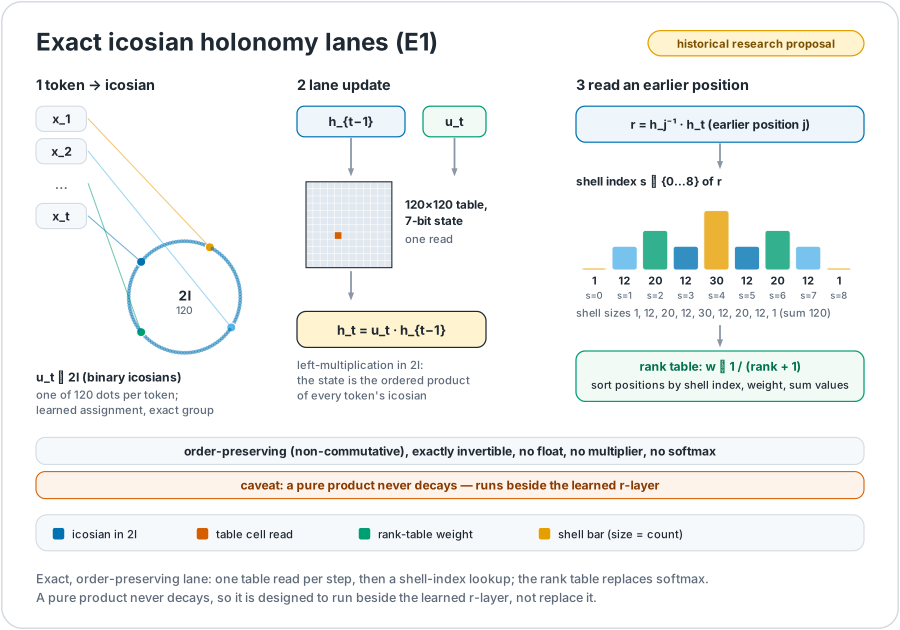
A historical proposal for remembering order with exact group elements.
A lane state is a product in the 120-element group, updated by one read of a \(120\times120\) table: \(h_t = u_t h_{t-1}\). To read an earlier position \(j\), form the relative element \(h_j^{-1}h_t\) and use its shell index, 0 to 8, to rank that position. This design is not on the current path. It was pre-registered as the experiment called E1 (not the same thing as check E1 above), and it needs its own pre-registration and a TEST FITNESS: FIT review before any compute. An August recursive-attention configuration that kept one reusable summary state lost the order of earlier tokens (the August A1.0 record). Separately, the retrieval arms also called A1 were stopped on 1 October under D18 because every arm scored below 0.5 recall at distance 16. Under D22 that closes the configuration, not the mechanism.
Where the model uses this
| Mechanism | Status | Use of E8 or the icosians |
|---|---|---|
| Discrete learning, route read, flock read | ACTIVE | The 16-root orbit and its 64 signed actions are the carrier. Not full E8 coverage |
| Prime-zeta codebook | ACTIVE | Each 8D block of the starting table is aligned to the 16-root orbit by exact integer scores under cell quotas and uniqueness passes |
| SpiralCore/FBS projection | READY (float), ACTIVE (integer form) | Moves a chosen block along exact E8 steps |
| Spin-native weights | PARKED | Single-icosian snap (each quaternion weight block to one of the 120 icosians): after training, +0.141 bits per byte; trained in, +0.103 to +0.140; both negative (record). A two-icosian pair with a 2-bit scale matched an equal-parameter dense model (+0.0012) but only through dense matrix multiplication, which is barred |
| E8 orbit memory | PARKED | Fixed E8 addresses for a large table. It stayed within its quality bar at 0.033 bits per byte worse than a dense control, but learned keys beat it by 0.023 |
Retained experiments such as these have results that concern those configurations. They do not settle the full geometry programme.
Where it stands
| Claim | Kind | Source |
|---|---|---|
| \(2I\) has 120 elements, 720 edges and the shell counts above | proof / finite enumeration | verify_connections.py |
| \(2I\cup\varphi\cdot2I\) is a rank-8, norm-2, reflection-closed set of 240 roots under the reduced metric | finite enumeration (check E2) | same script |
| The signed matrices preserve the 240 standard-coordinate roots | finite enumeration (check E1) | same script |
| A map between the two E8 realizations that carries the actions | not established | anchors.rs header |
| M1 covers all of E8 | no | M1 uses a 16-root orbit (build.rs) |
| E8 or icosian structure improves language | not shown | the tried forms are on the board above |
Go deeper
- Next: Golden integers, the exact arithmetic behind these coordinates.
- Code:
anchors.rs,build.rs,verify_connections.py. - The mechanism pages above, and the overview.