Primes and zeta phases
Every prime number is a unique, indivisible building block, and every whole number is a product of primes in exactly one way. UOR-R4 uses that as an exact-identity idea: a word can be named by a prime (the current model M1 itself uses explicit token IDs). Separately, the project turns each prime into a set of angles using the known frequencies of the Riemann zeta zeros, as an optional input to the model's starting table; distinct starting vectors come from the allocation passes described below. This chapter explains both ideas and keeps them apart. The first is exact identity. The second is a way to scatter starting positions, and nobody has yet shown that its zeta angles help beyond simply keeping the words distinct. Terms are also defined in the glossary.
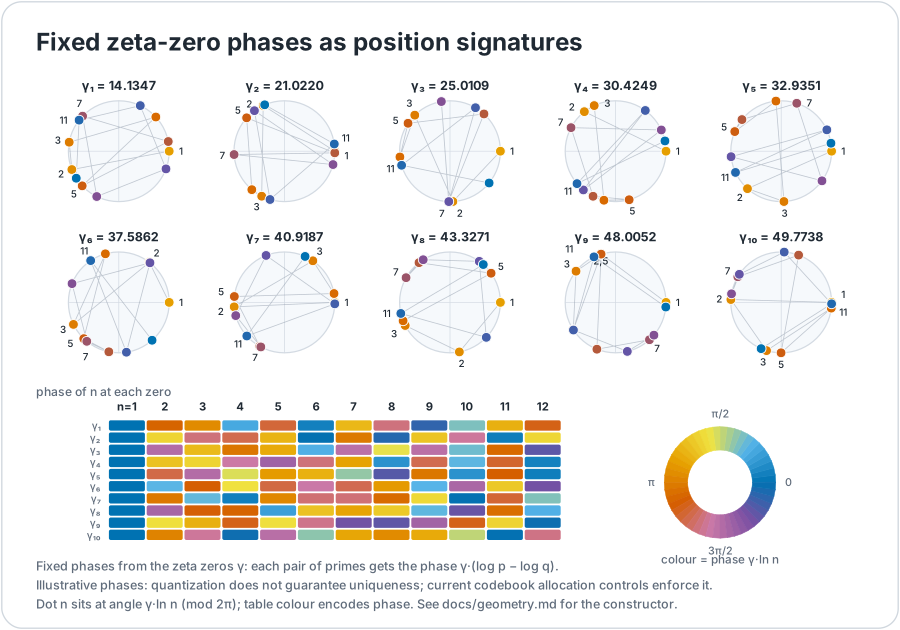
Fixed zeta-zero frequencies \(\gamma_k\) turn each prime \(p\) into one angle per zero, \(\theta_k=\gamma_k\ln p\). Think of a bank of clock hands, each turning at its own speed.
Zeta phases
The imaginary parts \(\gamma\) of the Riemann zeta zeros are fixed numbers. The first three are about 14.1347, 21.0220 and 25.0109. Each defines a phase frequency. For a prime \(p\) the phase on channel \(k\) is
\[\theta_k(p)=\gamma_k\ln p \pmod{2\pi},\qquad z_k(p)=\cos\theta_k+i\sin\theta_k .\]
A worked illustration (computed from the published value, not read from the code): for \(p=2\) and the first zero, \(\theta_1 = 14.1347\times\ln 2 \approx 9.797\), which is about \(3.514\) radians after subtracting \(2\pi\). Using a finite table of these constants does not require proving the Riemann hypothesis.
The optional offline prime_zeta.rs constructor uses four complex channels per block (\(\mathbb{C}^4\)) with \(\theta=\gamma\ln p\), and then:
- Realifies them into two 4-real tuples, \((\mathrm{Re}_0,\mathrm{Im}_0,\mathrm{Re}_1,\mathrm{Im}_1)\) and \((\mathrm{Re}_2,\mathrm{Im}_2,\mathrm{Re}_3,\mathrm{Im}_3)\).
- Normalises each with
UnitS3Q30::from_r4and quantises to Q30. - Applies the fixed coordinate permutation and exact integer alignment scores against the 16-root 8D carrier (see E8, H4 and the 600-cell).
- Allocates under writer-cell quotas and, when capacity permits, full-vector uniqueness controls. The output is
Snapshot.table.
So \(\mathbb{C}^4\) becomes \(\mathbb{R}^4+\mathbb{R}^4\) per block, not \(\mathbb{C}^8\) or \(\mathbb{R}^{16}\) per block. The allocation controls are part of the assignment. It is not simply an unconstrained nearest-root snap. Floating point appears only in this one-time offline step, under the October 14 zeta-zero exception, and the output is an integer table.
An honest caveat (proof, by reading the code). The quota and uniqueness passes also run on both matched control tables (one shifts every \(\gamma\) by 1.0, the other permutes the primes and scrambles phases and amplitudes). So the absence of collisions comes from those passes, not from prime phases. The record is prime-zeta construction; the mechanism page is prime-zeta codebook.
The retained M2 learner used the same fixed phases in a different way: it accumulated fixed phase bins as policy inputs (engine.rs). That historical use is distinct from the current codebook initialisation, and it does not establish learned M1 attribution to zeta phases.
Prime addressing
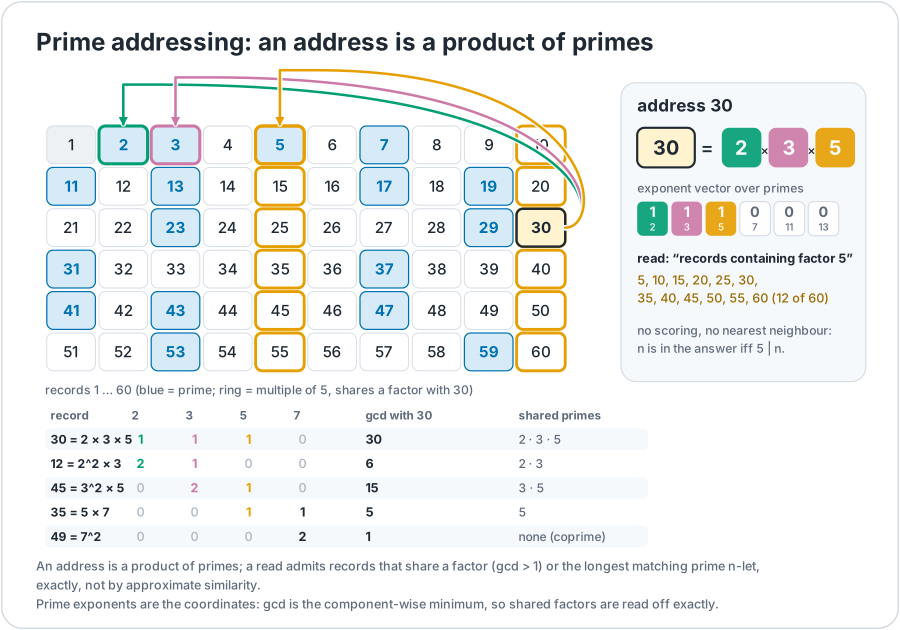
Distinct primes make shared factors exact. A product records which primes are present, not their order or how many times each appears.
Assign each token identity its own prime. Then shared factors are exact, by unique factorisation (proof). For example, with primes \(2,3,5,7\) standing for four tokens, the products \(42=2\cdot3\cdot7\) and \(105=3\cdot5\cdot7\) have \(\gcd=21=3\cdot7\), which says exactly that the two sets share tokens 3 and 7. A product of distinct primes records a set. Sequence order and multiplicity need explicit additional representation: \(2\cdot3=3\cdot2\), and \(12=2\cdot2\cdot3\) needs exponents to be told from \(6=2\cdot3\). Exact identity is not a semantic metric. Two different primes are different, and nothing more is learned from their size or product.
What the current model does with this
Current M1 uses explicit token IDs and an ordered BinderPlan context, plus the optional prime-addressed initialiser above. Flock and Relation reads rank finite context nodes and transport payloads before the shared writer.
A bounded kept-K list limits how many contributions are retained. It does not bound selection cost: the kernel scans eligible nodes, and Relation adds graph scans. The writer also scans vocabulary occupancy and admitted-cell tokens. See the cost and source discussion.
On 18 October the prime-zeta table was wired in as the model's starting table. Before that, a random start gave 4,096 words only 16 different starting vectors. The table gives all 4,096 distinct vectors (prime-zeta construction, wiring). The 19 October zero-update pre-flight then found that, at K=8, only about 8 of 256 target cells were opened, so admitted words were 127 of 3,847 against a gate of 500, and the run was not started (pre-flight). That closes the configuration "spread words evenly at K=8". It does not test whether zeta phases help.
Where the model uses this
| Mechanism | Status | Use |
|---|---|---|
| Prime-zeta codebook | ACTIVE | The starting table. The trained comparison against its two controls is NOT_RUN |
| Address-structured cells | ACTIVE | Places each word next to the words that usually precede it; the prime-zeta table is its fallback cell |
| Admission | ACTIVE | Narrows 4,096 words to those in a few opened cells. The measured ceiling on every attention run |
| Exact addressed memory | PARKED | Writes a fact once under an exact prime address. The trained forms failed or used softmax; the address-as-read form was never built |
| Pointer key | PARKED | Copies by a slot's exact name. A softmax pointer; hit rate rose from 0.377 to 0.545, but memory missed its bar |
| Object store | READY | Preserves exact bytes separately in a hashed tree. It is not integrated into the M1 token path |
The D19 object store preserves exact bytes separately. It is not silently integrated into the M1 token path. The retained native learner and the addressed-memory and pointer-identity mechanisms remain research foundations with their own artifact-bound evidence.
Where it stands
| Claim | Kind | Source |
|---|---|---|
| Distinct primes make shared factors exact | proof | unique factorisation |
| Each of 4,096 words gets a distinct starting vector | measurement | construction record |
| Zeta phases beat the matched controls in training | NOT_RUN | prime-zeta codebook |
| Prime identity is a semantic distance | no | exact identity only |
| The model has a measured language gain from either idea | no | pre-alpha; see STATUS.md |
Go deeper
- Code:
prime_zeta.rs,prime_route_attention.rs. - Next: VSA and Hamming distance. Back to the overview.